I'm trying to decide whether or not to enter The 6th Annual Alaska Break-Up Contest. I like the sound of it because it's a welcome change from the "First Meet" which always seems to focus on the first 30 pages or so of the manuscript. Not that I have a problem with my first 30 pages, but I've had lots of feedback, having entered them several times, both in local contests and in RWA's Golden Heart. And I do actually love the scene in What the Heart Remembers that sees the characters break up - it was a tough scene to write, but I believe it is a strong one.
Still, it's been a while since I've entered a contest and I know they can be real crap shoots (if you'll excuse the expression). While most judges are great, one can occasionally draw a judge who either just doesn't get your work or who doesn't have either the experience to do the job properly or the interest in certain types of stories. OTOH, I realize that this might be the best way to get back into the swing of things before submitting again.
What do you think of contests? Have you entered any lately?
Teresa
Monday, March 18, 2013


Sunday, March 17, 2013
Revitalizing my neglected blog...
I have been terribly neglectful of my blog of late, I cannot deny that. While I was in school, I blamed my workload for my rare posts, but I've been done for almost a year now and still have been uninspired to post. It's odd, really, as I love this blog and have been keeping it up, at one pace or another for over seven years now.
Part of the problem, I believe, is not being focussed enough. Since finishing school I've been caught up at work, both my official job at the library and my volunteer work at the local museum. My writing has suffered as a result, though I am making more of an effort these days. I think a lot of the reason for my lack of interest in the blog lately relates directly to spending 3 1/2 years meeting constant deadlines in school. Having to blog felt like another of those deadlines. However, now, I find I'm missing it.
My writing is at a crossroads of sorts. Part of me wants to keep working on the three unfinished mss I already have, yet another part wants to go in a completely different direction. Every time I think I might be able to abandon one of those mss, the characters protest and I come back to the. That tells me that really, I have to write their stories before I can move on.
The biggest obstacle, however, is the problem with my plotting. I've mentioned this over on Facebook - my sudden inability to clearly see the end of the story. A plotter by nature, I've learned that I have to have at least a general outline of the story before I can move to far with it. That doesn't mean I have things worked out scene by scene down to the last detail and won't deviate, but it does mean I need to have a specific final scene in my head. With my earlier mss, this was always the case - the scenes were there from very early on in the writing process. Yet now, it just doesn't happen. I can't tell if this means it's the wrong story, the wrong characters or just that my mind is now filled with so many other details, that I"m not able to focus on my writing.
I did work before, but I wasn't as involved with it as I am with my work at the library. Part of that revolves around my work with the public - I give a lot of myself during the day, so a lot of my energy that would go to my creative side gets drained. Also, at least while I was writing my first ms, I used the writing as an escape from a job I really didn't like much at all. That is not the case now. OTOH, every time I think maybe I should just forget about writing, my characters protest very loudly and draw me back into their worlds.
Learning to balance my work life with my writing life is something I have to work on. Unlike some of my writing friends, I cannot function in that capacity at 5 am - I wish I could, but I just can't. The most I can do just after 6 am is drag myself down to the elliptical trainer or my yoga mat. My brain has never engaged at that early an hour. So it's back to evenings again - something I had to do in school. I fooled myself into believing that I'd be so well trained from doing work at night that it would translate to my writing. No such luck - I found I was so relieved to NOT have to do work in the evenings, I only wanted to read or surf the web.
Now, however, I realize that I have little choice - my characters want their stories to be told and given that I have evenings relatively free, I have to dedicate at least some of that time to my writing. No excuses. Writing has been a part of my life for so long that I can't just give up on it now, especially when it's clear that the stories are still viable, given that my characters demand my attention.
I'm hoping that by blogging about writing related topics again, on a frequent basis, that I will keep myself more focussed on writing and begin to produce new work on a much more regular basis.
What about you? How do you stay foccussed on your work?
Teresa
Part of the problem, I believe, is not being focussed enough. Since finishing school I've been caught up at work, both my official job at the library and my volunteer work at the local museum. My writing has suffered as a result, though I am making more of an effort these days. I think a lot of the reason for my lack of interest in the blog lately relates directly to spending 3 1/2 years meeting constant deadlines in school. Having to blog felt like another of those deadlines. However, now, I find I'm missing it.
My writing is at a crossroads of sorts. Part of me wants to keep working on the three unfinished mss I already have, yet another part wants to go in a completely different direction. Every time I think I might be able to abandon one of those mss, the characters protest and I come back to the. That tells me that really, I have to write their stories before I can move on.
The biggest obstacle, however, is the problem with my plotting. I've mentioned this over on Facebook - my sudden inability to clearly see the end of the story. A plotter by nature, I've learned that I have to have at least a general outline of the story before I can move to far with it. That doesn't mean I have things worked out scene by scene down to the last detail and won't deviate, but it does mean I need to have a specific final scene in my head. With my earlier mss, this was always the case - the scenes were there from very early on in the writing process. Yet now, it just doesn't happen. I can't tell if this means it's the wrong story, the wrong characters or just that my mind is now filled with so many other details, that I"m not able to focus on my writing.
I did work before, but I wasn't as involved with it as I am with my work at the library. Part of that revolves around my work with the public - I give a lot of myself during the day, so a lot of my energy that would go to my creative side gets drained. Also, at least while I was writing my first ms, I used the writing as an escape from a job I really didn't like much at all. That is not the case now. OTOH, every time I think maybe I should just forget about writing, my characters protest very loudly and draw me back into their worlds.
Learning to balance my work life with my writing life is something I have to work on. Unlike some of my writing friends, I cannot function in that capacity at 5 am - I wish I could, but I just can't. The most I can do just after 6 am is drag myself down to the elliptical trainer or my yoga mat. My brain has never engaged at that early an hour. So it's back to evenings again - something I had to do in school. I fooled myself into believing that I'd be so well trained from doing work at night that it would translate to my writing. No such luck - I found I was so relieved to NOT have to do work in the evenings, I only wanted to read or surf the web.
Now, however, I realize that I have little choice - my characters want their stories to be told and given that I have evenings relatively free, I have to dedicate at least some of that time to my writing. No excuses. Writing has been a part of my life for so long that I can't just give up on it now, especially when it's clear that the stories are still viable, given that my characters demand my attention.
I'm hoping that by blogging about writing related topics again, on a frequent basis, that I will keep myself more focussed on writing and begin to produce new work on a much more regular basis.
What about you? How do you stay foccussed on your work?
Teresa
Thursday, September 20, 2012
Review: Before Versailles by Karleen Koën
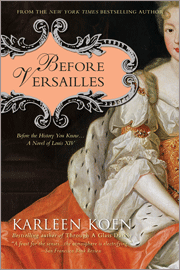 The Sun King, "L'état, c'est moi." Versailles...These are the first three things that come to mind where Louis XIV of France is concerned. But what about before he became the all-powerful monarch? Karleen Koën's fourth novel, Before Versailles, published this month in trade paperback by Sourcebooks, focusses on five months of the young king's life during the spring and summer of 1661, soon after he began his personal rule. Until then his mother, Anne of Austria (a Spanish princess) had been regent, guided by Cardinal Mazarin.
In May of 1661, Louis had been married to Maria-Teresa of Spain for almost a year and she was pregnant with his first child. The court was at Fontainebleu and had recently welcomed Louis' cousin and sister-in-law, Henriette, sister of Charles II of England. Into this glittering company came a young, impoverished noblewoman, Louise de la Baume le Blanc, to serve as one of Henriette's maids of honour. It is through her eyes that Koën tells the story.
An innocent in many ways, Louise is thrilled to have escaped the boredom of the Orléans household, in which she had served, to join the court of the young king. Soon she is caught up in the intrigue and jealousies of the king, his brother, his sister-in-law and the young queen. Additionally, she encounters a strange young man in an iron mask and seeks to learn his identity and the reason his face is kept hidden.
Counselling her are her cousin, François-Timoléon de Choisy and her friend Fanny de Montalais, another maid of honour. As the summer progresses, Louise finds herself drawn into a relationship with the king after confiding in him about the boy in the mask. Their love blossoms, but remains hidden from the prying eyes at court, while at the same time Louis grasps the reins of power for himself, seeking to eliminate all those who challenge him.
Known for her dedication to period detail and tight plotting, Ms. Koën has produced a masterpiece of historical fiction. The story starts slowly, introducing characters and laying the groundwork for a multi-threaded story that culminates in Louis' independence from all who seek to control him. By a third of the way through the book, the reader is reluctant to put it down as Louise and Louis begin their inexorable dance towards each other.
But it is more than the love story that entices, it's the brilliant portrayal of a court full of so many undercurrents it's amazing its inhabitants don't drown. Add in the smallest attention to dress, food, flora, fauna, architecture and social history, and it is little wonder that dedicated readers of historical fiction rave about Ms. Koën's work.
I loved her characterization of Louis XIV, as a young man transforming himself into the Sun King, taking control of his government, yet still maintaining some sense of himself as just a man, caught in a situation over which he has little control - married to a woman he doesn't love and whose destiny it is to rule a kingdom.
Louise also stands out, growing in confidence and maturity as she navigates the increasingly dangerous waters of a court obsessed with power and position. A typical teenaged girl of the time, she swings between poor judgement in some situations and acts of genuine empathy - it is easy to see why Louis is drawn to her. She is not perfect, nor does she behave like the more experienced women at court who sacrifice their souls to achieve power and wealth.
The supporting characters also shine, from the child-like queen to Viscount Nicholas, from Louis' brother Philippe to his mother's former lady-in-waiting, the Duchess de Chevreuse. Each has a role to play that adds to the story's depth without detracting from the central plot.
I did notice that on a few occasions Ms Koën hints to the reader of what will happen to certain characters beyond the scope of the book. This sporadic use of the omniscient pov would, in the hands of a less experienced writer, prove annoying and distracting, yet her skill is such that those passages fit naturally into the narrative.
Ultimately, what makes this work a successful and enthralling piece of historical fiction is the absolute sense of place and the believability of the characters and their mindset. Their motivations rang true and it was easy to get caught up in their lives, so easy, in fact, that I was disappointed when I reached the final chapter. This book is a veritable feast for anyone interested in 17th century France and its star, Louis XIV.
Subscribe to:
Posts (Atom)